Wave goodbye to

Wave goodbye to

Project overview

Project overview

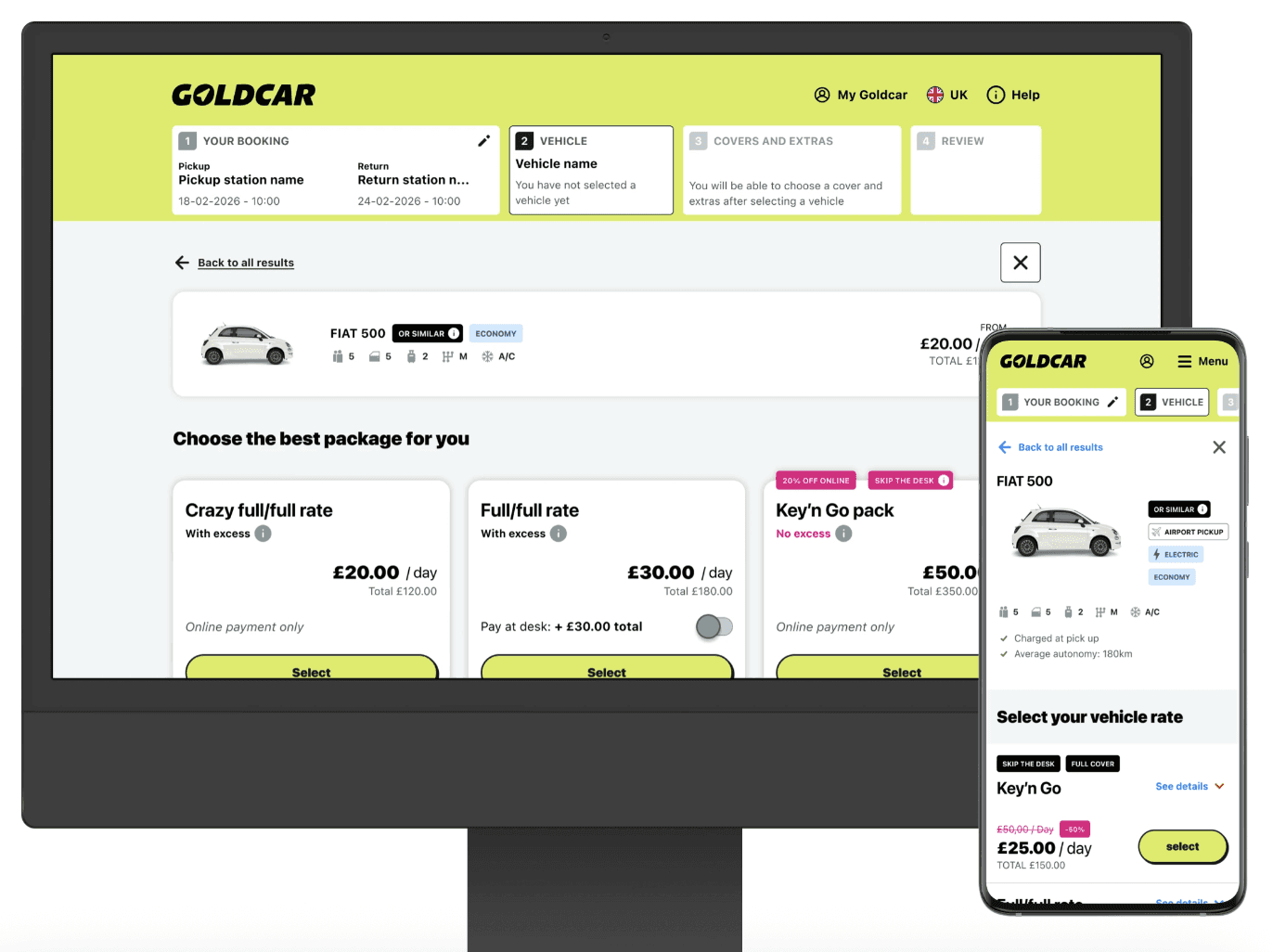
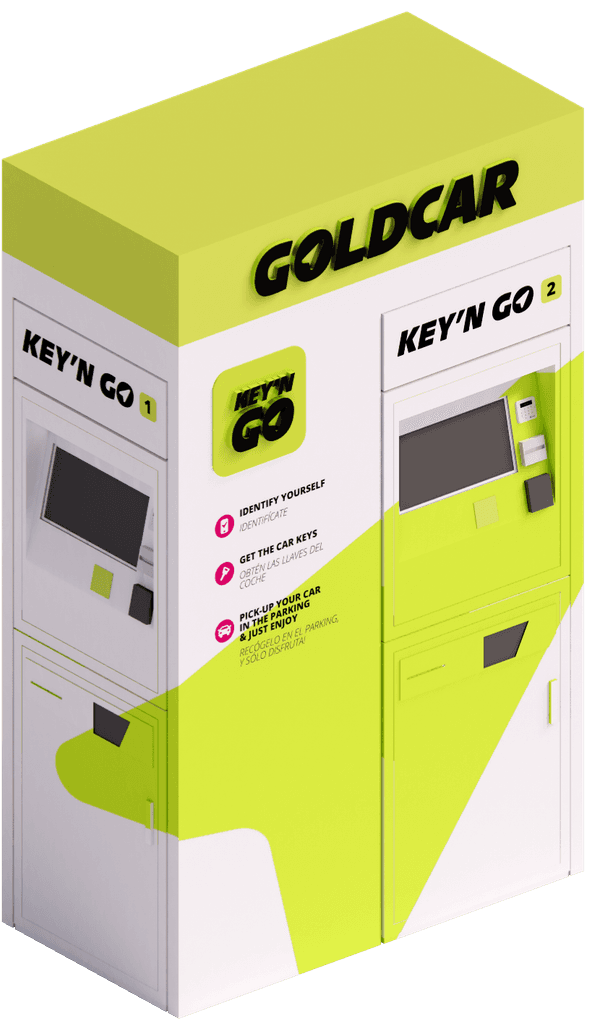
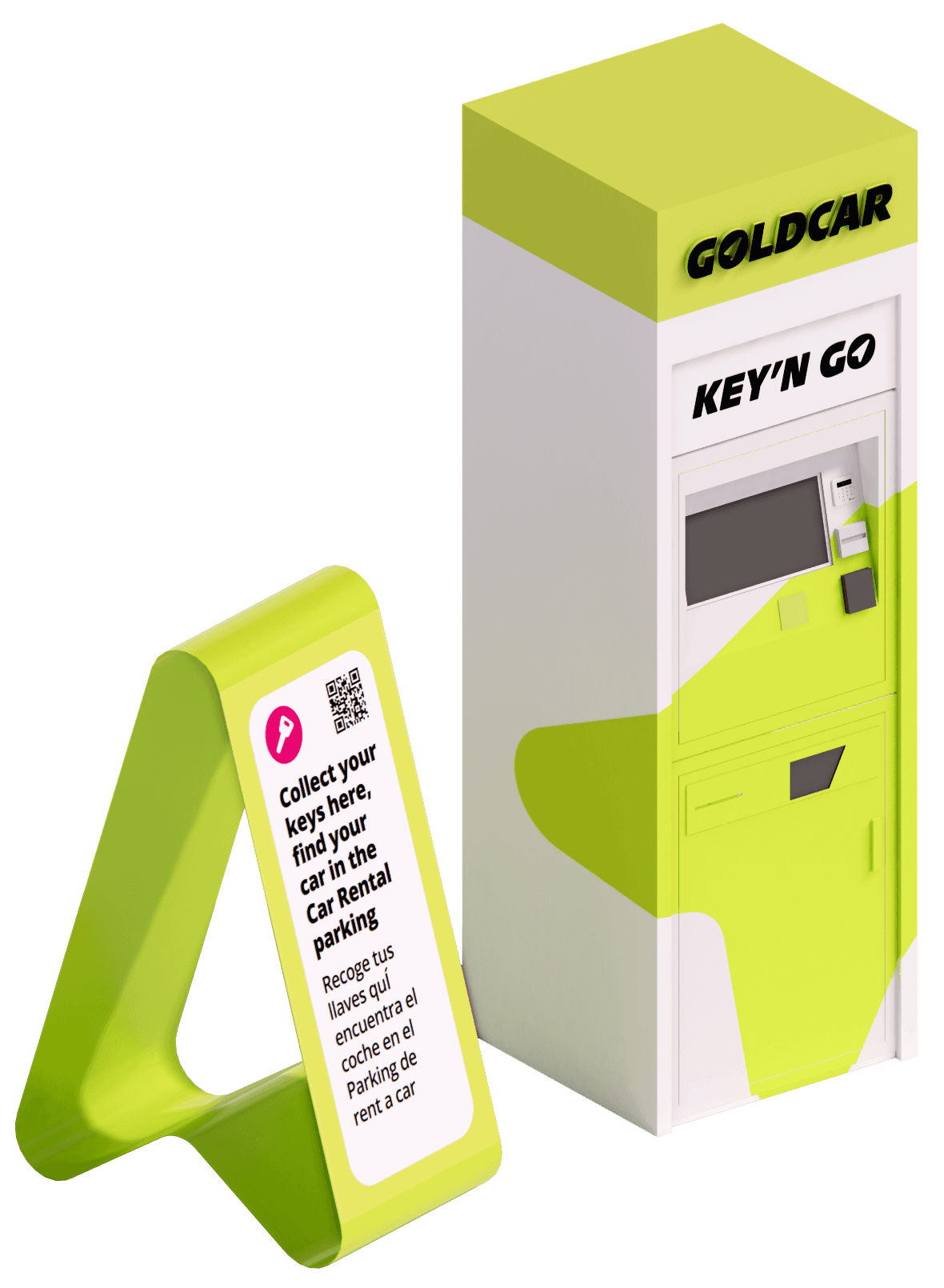
Key’n Go is Goldcar’s self-service kiosk solution, designed to streamline the rental experience by allowing customers to skip the counter and go straight to their car. While the product delivered on speed and convenience, it lacked one of the most important value drivers for the business: the ability to upsell.

Traditionally, staff at the counter played a key role in offering upgrades and add-ons. But with 27% of global rentals—over 238,000 bookings last year—now taking place through Key’n Go, the absence of a digital upselling strategy represented a significant missed opportunity.


This project set out to integrate upselling into the Key’n Go flow in a way that respected the self-service promise. The goal was to bring the business impact of counter-based sales into the kiosk experience without slowing users down or compromising trust. We focused on designing a seamless, persuasive, and contextual interaction that could surface relevant offers while maintaining the product’s core advantage: speed and autonomy.

Insurance

Offers extra road assistance and enhanced coverage options to reduce customer liability.

  • Protection

  • Assistance

  • Peace

Insurance

Offers extra road assistance and enhanced coverage options to reduce customer liability.

  • Protection

  • Assistance

  • Peace

Insurance

Offers extra road assistance and enhanced coverage options to reduce customer liability.

  • Protection

  • Assistance

  • Peace

Vehicle upgrade

Allows customers to choose a higher car category for added comfort or performance.

  • Comfort

  • Style

  • Performance

Vehicle upgrade

Allows customers to choose a higher car category for added comfort or performance.

  • Comfort

  • Style

  • Performance

Vehicle upgrade

Allows customers to choose a higher car category for added comfort or performance.

  • Comfort

  • Style

  • Performance

Extra equipment

Our pre recorded sessions contain all the essentials to help you fix your mood.

  • Safety

  • Navigation

  • Convenience

Extra equipment

Our pre recorded sessions contain all the essentials to help you fix your mood.

  • Safety

  • Navigation

  • Convenience

Extra equipment

Our pre recorded sessions contain all the essentials to help you fix your mood.

  • Safety

  • Navigation

  • Convenience

Extra driver

Allows a second person to legally drive the rental car.

  • Ask

  • Freedom

  • Travel

Extra driver

Allows a second person to legally drive the rental car.

  • Ask

  • Freedom

  • Travel

Extra driver

Allows a second person to legally drive the rental car.

  • Ask

  • Freedom

  • Travel

Countries

Grants permission to drive the rental vehicle across international borders.

  • Ask

  • Freedom

  • Travel

Countries

Grants permission to drive the rental vehicle across international borders.

  • Ask

  • Freedom

  • Travel

Countries

Grants permission to drive the rental vehicle across international borders.

  • Ask

  • Freedom

  • Travel

Smart return

Lets customers return the car with any fuel level, avoiding refueling charges.

  • Convenience

  • Flexibility

  • Savings

Smart return

Lets customers return the car with any fuel level, avoiding refueling charges.

  • Convenience

  • Flexibility

  • Savings

Smart return

Lets customers return the car with any fuel level, avoiding refueling charges.

  • Convenience

  • Flexibility

  • Savings

Role & Team

Role & Team

I led the design of this initiative as the Product Designer embedded within the digital self-service stream at Goldcar. My role covered end-to-end responsibilities: from framing the problem with stakeholders to conducting field research, ideating and prototyping upselling touchpoints, and testing them with real users. I also collaborated closely with our analytics team to define success metrics and track impact post-launch.

The project was a multidisciplinary effort involving Product, Engineering, Marketing, and Operations teams. We worked in tight feedback loops to ensure business goals aligned with user needs and operational constraints. Close coordination with country managers and station staff was essential to understand contextual differences across markets and ensure a consistent experience globally.

Self-service boost

Redesigned the full experience to make it faster, clearer, and more intuitive.

Self-service boost

Redesigned the full experience to make it faster, clearer, and more intuitive.

Self-service boost

Redesigned the full experience to make it faster, clearer, and more intuitive.

Faster, smarter rentals

Streamlined key customer touchpoints to minimize friction and get people on the road faster—especially during peak hours.

Faster, smarter rentals

Streamlined key customer touchpoints to minimize friction and get people on the road faster—especially during peak hours.

Faster, smarter rentals

Streamlined key customer touchpoints to minimize friction and get people on the road faster—especially during peak hours.

Your booking is ready

12:41 AM

You’re ready to pick up your car.

Head to the Key’n Go machine

10:41 AM

Scan your QR code to get your keys in seconds.

Booking Started – Park spot Nº 57

20:41 AM

Your car is waiting. Head to spot 57 and hit the road.

Millions in revenue unlocked

Through UX improvements and upselling strategies across kiosk and counter touchpoints.

Your booking is ready

12:41 AM

You’re ready to pick up your car.

Head to the Key’n Go machine

10:41 AM

Scan your QR code to get your keys in seconds.

Booking Started – Park spot Nº 57

20:41 AM

Your car is waiting. Head to spot 57 and hit the road.

Millions in revenue unlocked

Through UX improvements and upselling strategies across kiosk and counter touchpoints.

Your booking is ready

12:41 AM

You’re ready to pick up your car.

Head to the Key’n Go machine

10:41 AM

Scan your QR code to get your keys in seconds.

Booking Started – Park spot Nº 57

20:41 AM

Your car is waiting. Head to spot 57 and hit the road.

Millions in revenue unlocked

Through UX improvements and upselling strategies across kiosk and counter touchpoints.

Sustainability

Helped advance its paperless and automation objectives, contributing to both environmental and operational impact.

Sustainability

Helped advance its paperless and automation objectives, contributing to both environmental and operational impact.

Sustainability

Helped advance its paperless and automation objectives, contributing to both environmental and operational impact.

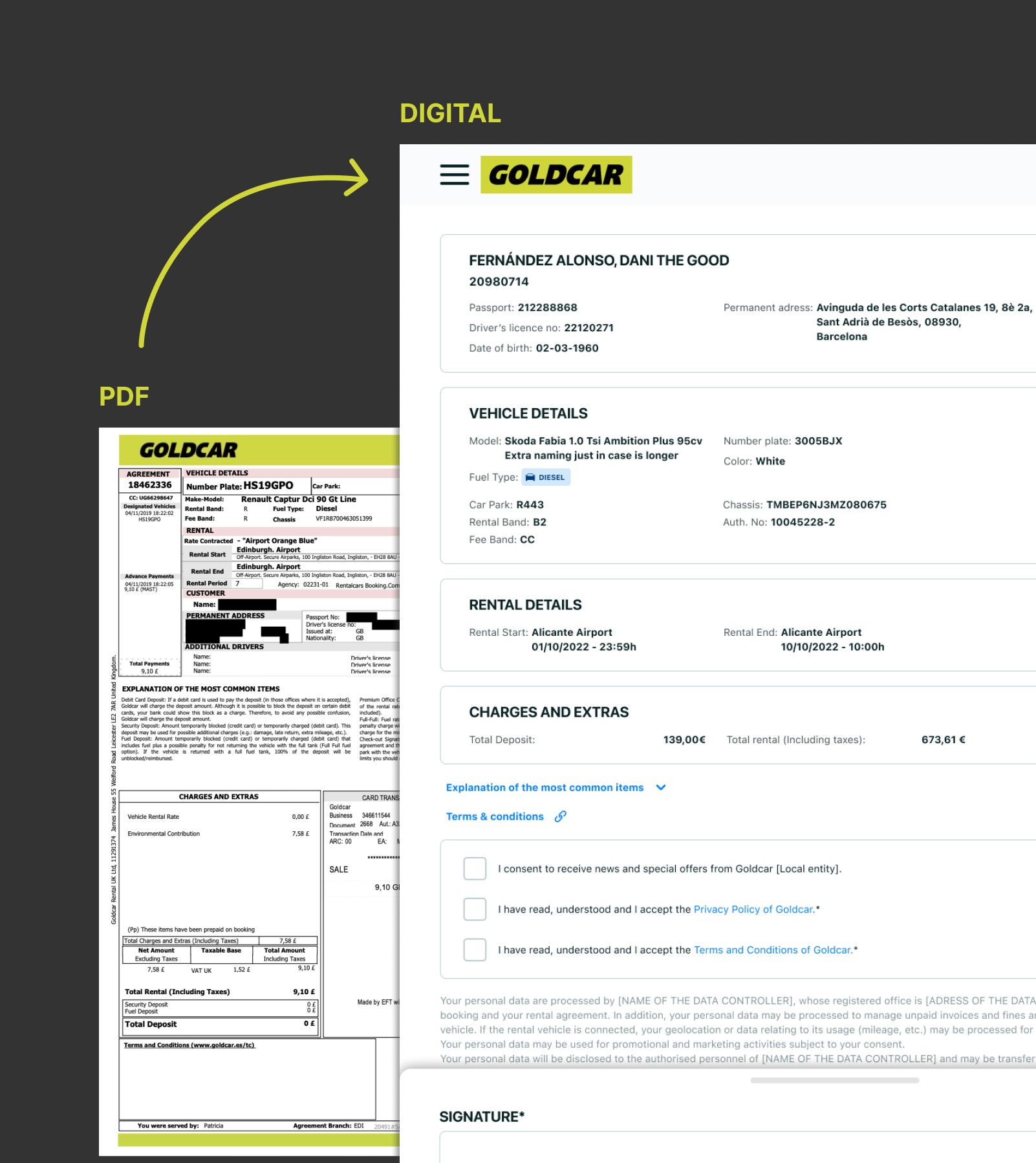
Paperless rental agreement

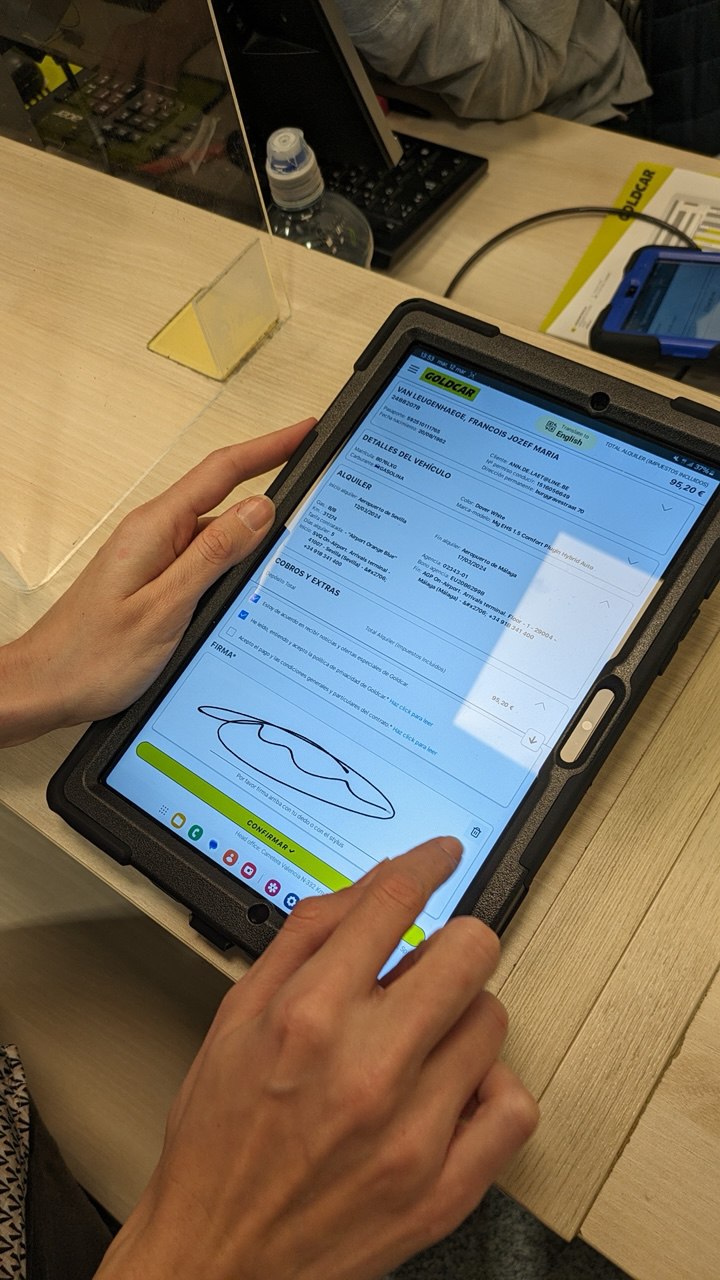
Eliminated paper from the signing process while enhancing transparency and reducing operational hassle for both customers and staff.

Paperless rental agreement

Eliminated paper from the signing process while enhancing transparency and reducing operational hassle for both customers and staff.

Paperless rental agreement

Eliminated paper from the signing process while enhancing transparency and reducing operational hassle for both customers and staff.

Upselling made seamless

Designed a smooth, visual experience to help customers explore upsellings.

Upselling made seamless

Designed a smooth, visual experience to help customers explore upsellings.

Upselling made seamless

Designed a smooth, visual experience to help customers explore upsellings.

Discovery

Discovery

Before this project, the Key’n Go experience didn’t offer any upselling opportunities at the moment of pick-up. While the counter channel actively promoted add-ons like insurance, vehicle upgrades, or equipment, the self-service journey was limited to what users selected during online booking. With 27% of global rentals going through Key’n Go, this was a major untapped opportunity to improve both revenue and user experience.

The discovery phase focused on understanding how and when to introduce ancillary offers within the kiosk flow, without compromising its core promise: speed and simplicity. We explored user behavior at the machine, operational workflows, and legal constraints across markets to ensure we could deliver a persuasive, compliant, and scalable upsell solution.

Before this project, the Key’n Go experience didn’t offer any upselling opportunities at the moment of pick-up. While the counter channel actively promoted add-ons like insurance, vehicle upgrades, or equipment, the self-service journey was limited to what users selected during online booking. With 27% of global rentals going through Key’n Go, this was a major untapped opportunity to improve both revenue and user experience.

The discovery phase focused on understanding how and when to introduce ancillary offers within the kiosk flow, without compromising its core promise: speed and simplicity. We explored user behavior at the machine, operational workflows, and legal constraints across markets to ensure we could deliver a persuasive, compliant, and scalable upsell solution.

On site immersion

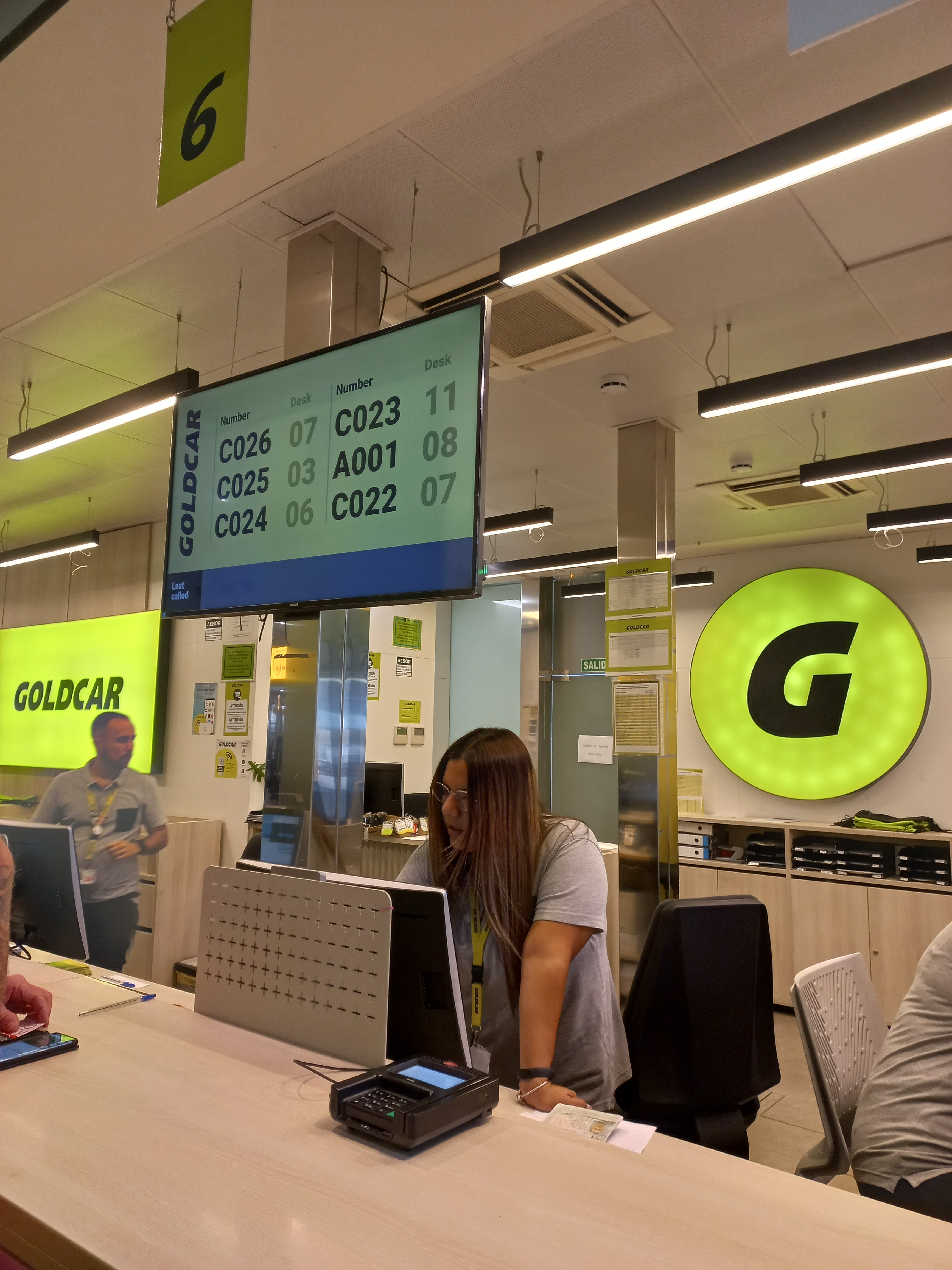
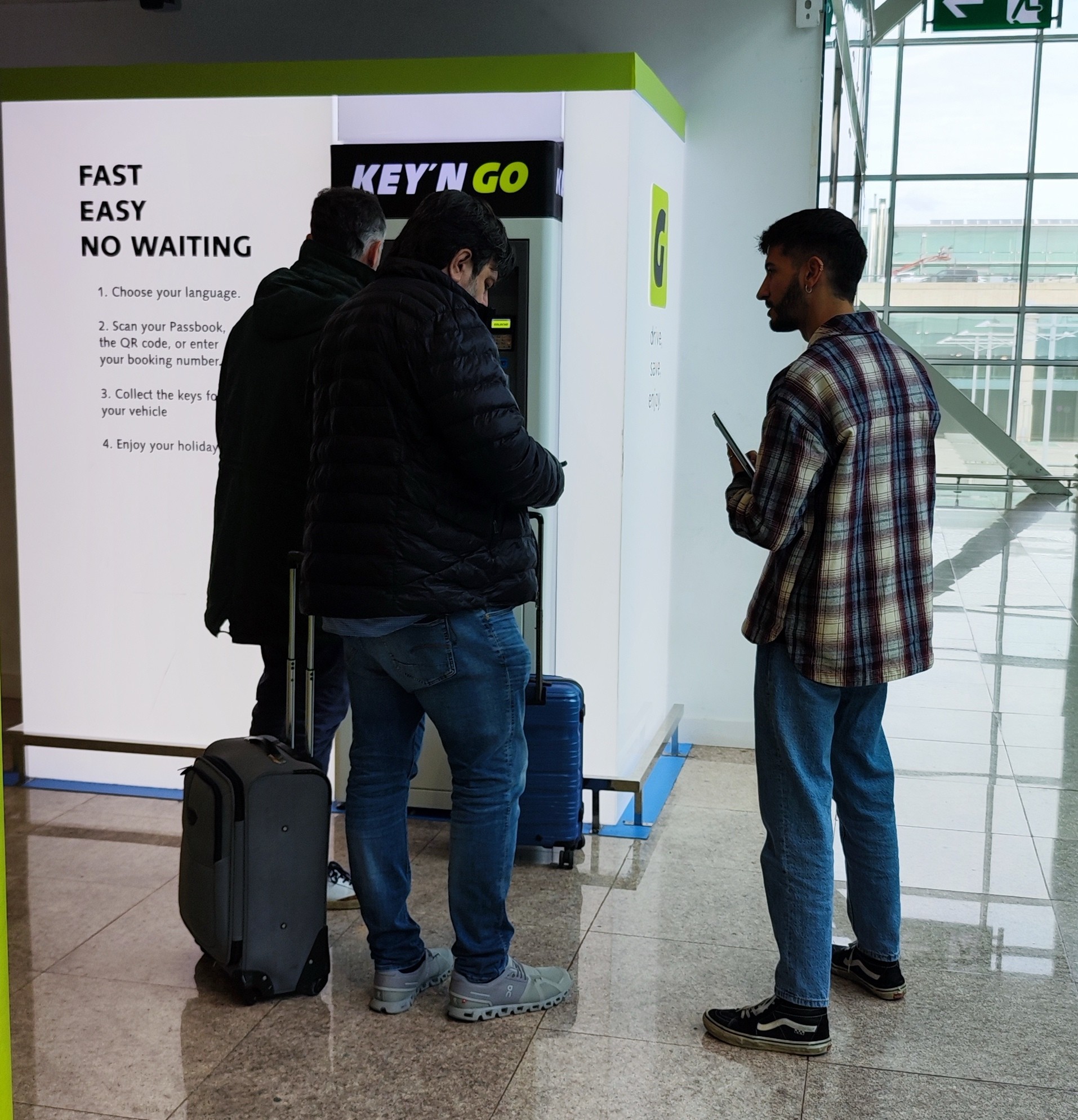
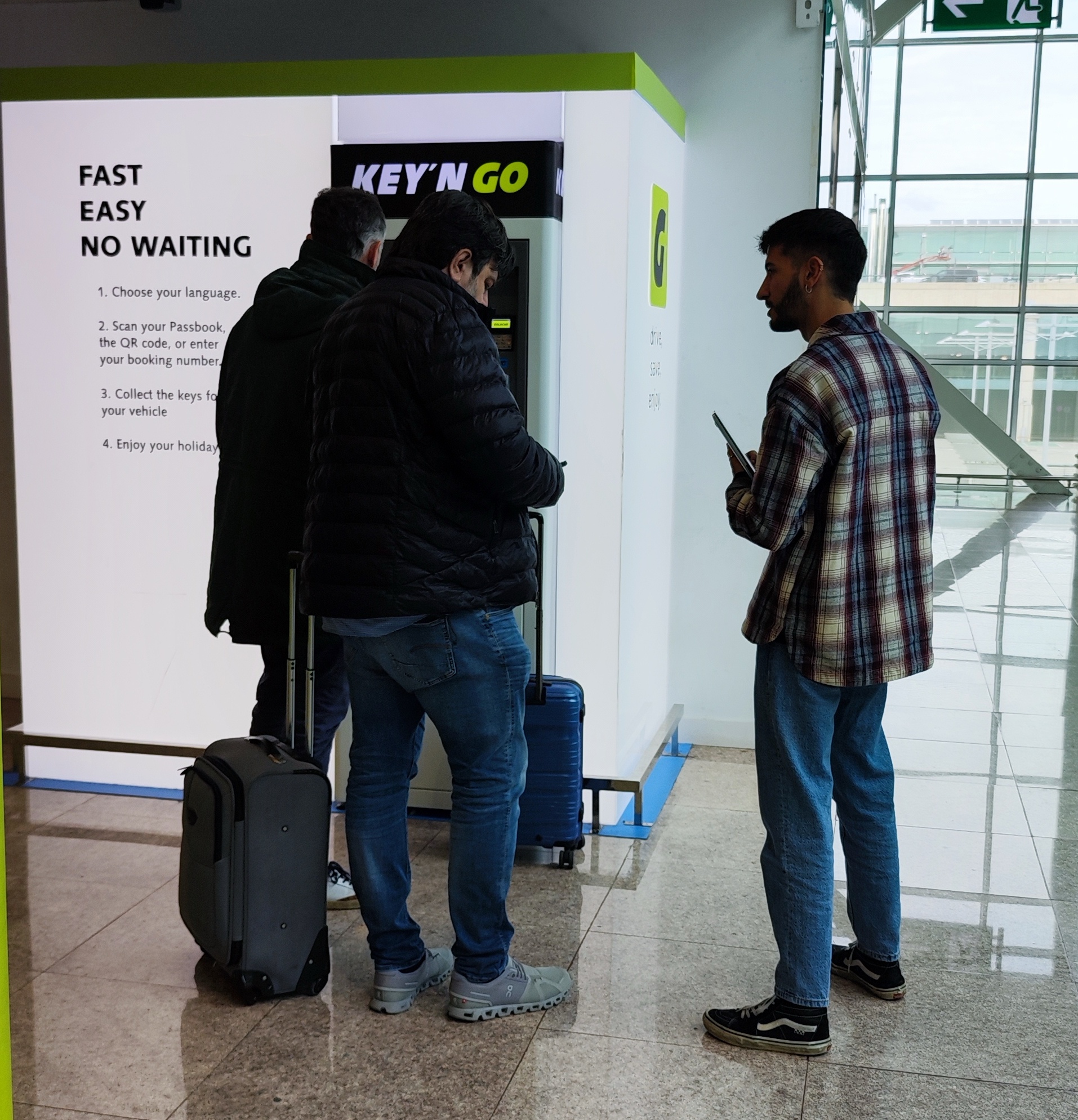
To ground our assumptions in reality, we conducted on-site visits to several Key’n Go stations across different countries. These sessions included shadowing station staff, observing customer behavior at the kiosks, and informally interviewing both employees and renters during the pick-up process. The goal was to capture unfiltered reactions, identify pain points, and understand environmental factors that influence decision-making.

What we saw confirmed a key insight: while users valued the speed and autonomy of Key’n Go, the interaction was often perceived as purely transactional. There was little room for reflection or discovery of additional services. Unlike the counter, where staff could explain, reassure, and adapt their pitch, the kiosk experience lacked prompts that could trigger curiosity or perceived value in extras. This gap was particularly clear in moments where users hesitated, scanned the screen quickly, or asked nearby staff for clarification — all strong signals of friction or missed opportunity.

Slide image or video
Shadowing

To ground our assumptions in reality, we conducted on-site visits to several Key’n Go stations across different countries. These sessions included shadowing station staff, observing customer behavior at the kiosks, and informally interviewing both employees and renters during the pick-up process. The goal was to capture unfiltered reactions, identify pain points, and understand environmental factors that influence decision-making.

What we saw confirmed a key insight: while users valued the speed and autonomy of Key’n Go, the interaction was often perceived as purely transactional. There was little room for reflection or discovery of additional services. Unlike the counter, where staff could explain, reassure, and adapt their pitch, the kiosk experience lacked prompts that could trigger curiosity or perceived value in extras. This gap was particularly clear in moments where users hesitated, scanned the screen quickly, or asked nearby staff for clarification — all strong signals of friction or missed opportunity.

Benchmarking

To broaden our perspective, we benchmarked how other industries and mobility players handle upselling in self-service contexts. We looked at rental car competitors, but also drew inspiration from sectors like hospitality and fast food, where digital kiosks have matured as sales channels. Brands like McDonald’s, hotel self-check-in systems, and airport e-gates provided valuable references on how to guide users through quick yet layered decision flows.

Among car rental competitors, we found limited examples of effective upselling at kiosks. Most focused on speed and skipped the opportunity entirely — or overwhelmed users with poor interface design. Outside the category, successful cases showed that timing, simplicity, and perceived relevance were key. Add-ons were introduced progressively, framed as enhancements, and paired with reassuring cues like customer ratings or “most selected” labels.

These insights helped us shape principles for our solution: keep the core flow uninterrupted, surface only what’s contextually relevant, and ensure the user always feels in control of the decision.

Mapping the journey

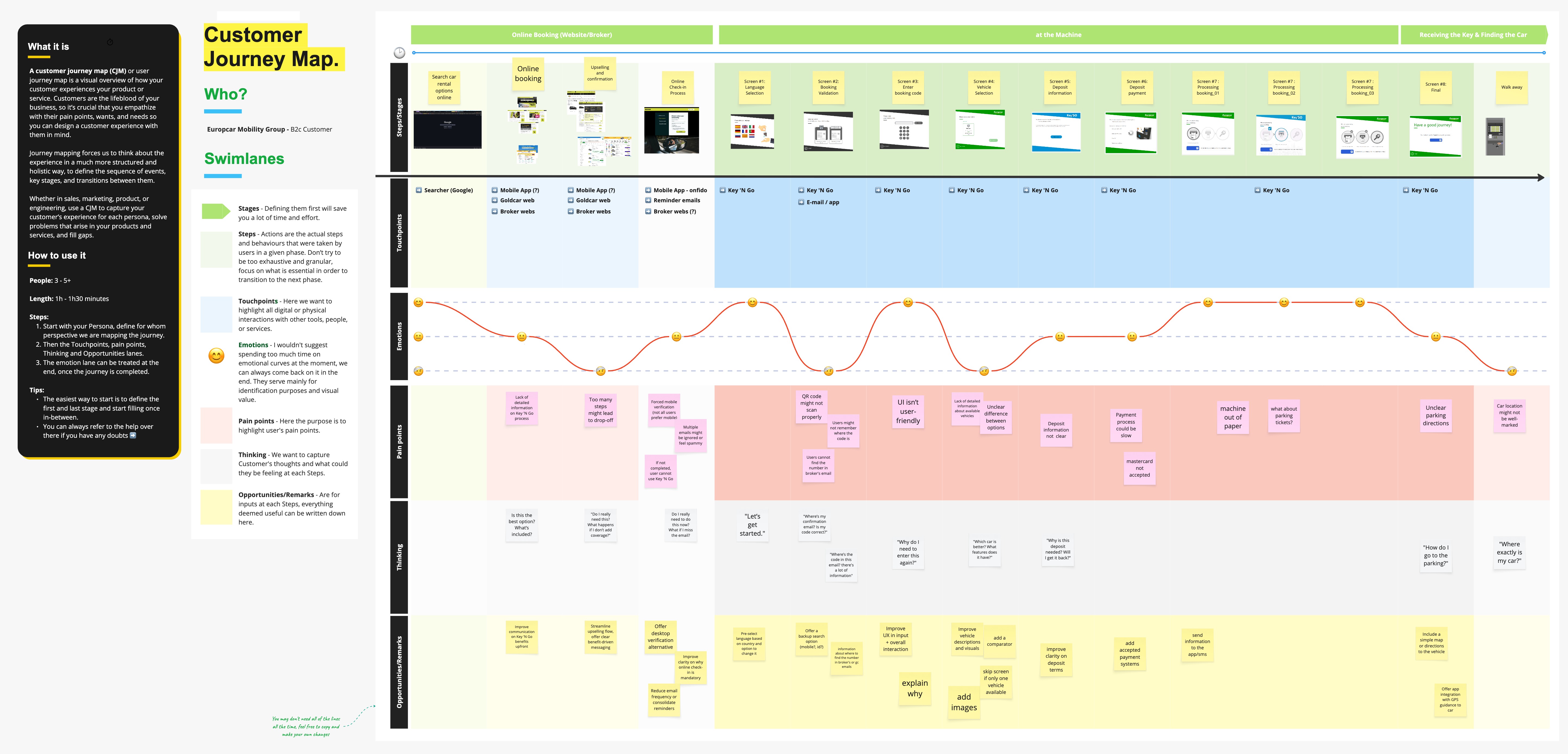
As part of this initiative, we quickly realized that introducing upselling at the Key’n Go machine wasn’t just about updating the kiosk interface — it had implications across the entire rental journey. To identify the right moments to inform, reassure, and engage users, we mapped the end-to-end experience: from booking to pick-up, including all touchpoints in between.

As part of this initiative, we quickly realized that introducing upselling at the Key’n Go machine wasn’t just about updating the kiosk interface — it had implications across the entire rental journey. To identify the right moments to inform, reassure, and engage users, we mapped the end-to-end experience: from booking to pick-up, including all touchpoints in between.


One key insight was that the decision to accept or ignore an upsell offer didn’t begin at the kiosk — it was shaped much earlier. That’s why we redesigned and reviewed all post-booking emails, with the goal of preparing users for what to expect when they arrived at the station. These touchpoints now reinforce the idea that add-ons can be reviewed or added later at the machine, giving users a sense of flexibility and transparency.By zooming out from just the machine UI, we ensured that the upselling experience felt connected and consistent across channels. Whether users were checking their email confirmation, approaching the kiosk, or interacting with the screen itself, the message was clear: you're in control, and you can shape your rental based on your needs.

One key insight was that the decision to accept or ignore an upsell offer didn’t begin at the kiosk — it was shaped much earlier. That’s why we redesigned and reviewed all post-booking emails, with the goal of preparing users for what to expect when they arrived at the station. These touchpoints now reinforce the idea that add-ons can be reviewed or added later at the machine, giving users a sense of flexibility and transparency.


By zooming out from just the machine UI, we ensured that the upselling experience felt connected and consistent across channels. Whether users were checking their email confirmation, approaching the kiosk, or interacting with the screen itself, the message was clear: you're in control, and you can shape your rental based on your needs.

Gradient 1 - Blue
Customer journey map

Data insights

To complement the fieldwork and journey mapping, we analyzed internal performance data to understand the revenue gap between desk and kiosk channels. One figure stood out immediately: while vehicle and insurance upsells at the counter reached up to 28% attachment rate (e.g., Mega Relax), Key’n Go customers showed virtually no upsell activity, simply because the offers didn’t exist at pick-up.

We also saw that in 2024, only 1.3% of Key’n Go rentals were manually upsold to Mega Relax at the counter — far below the 28% for non-automated journeys. In contrast, vehicle upgrades were accepted by 2% of kiosk users versus 6% at the desk. This pointed to a clear upside: even modest improvements to the kiosk experience could unlock significant revenue gains, especially considering that Key’n Go already represents 27% of Goldcar’s total rentals, or over 238,000 bookings annually.

In addition, insights from the KANTAR brand study highlighted the importance of protections and flexibility in shaping customer satisfaction — reinforcing our focus on ancillaries like coverage, smart fuel return, and crossborder. These signals gave us a strong quantitative baseline to prioritize which upsells to introduce and where to place them in the flow.

In addition, insights from the KANTAR brand study highlighted the importance of protections and flexibility in shaping customer satisfaction — reinforcing our focus on ancillaries like coverage, smart fuel return, and crossborder. These signals gave us a strong quantitative baseline to prioritize which upsells to introduce and where to place them in the flow.

Opportunities

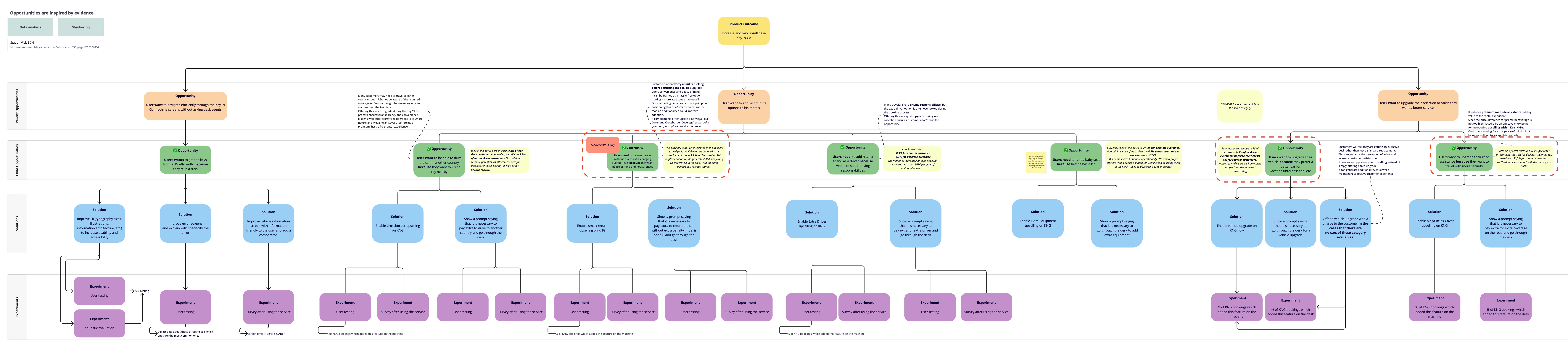
With research findings and data insights in hand, we consolidated everything into an opportunity map to visualize where the biggest impact areas were — both for the business and for users. We used the Opportunity Tree framework to connect desired business outcomes (e.g. increase ARPD, reduce operational dependency on counters) with customer needs and potential product interventions.


Key opportunities emerged around the pick-up experience at the kiosk. Customers wanted transparency, reassurance, and flexibility — but the current flow offered no chance to revisit or adapt their booking. On the business side, there was a clear goal to recover the ancillary revenue traditionally driven by human interaction. The overlap between these needs pointed us toward value-aligned interventions: contextual upsells, informative comparisons (especially for coverages), and frictionless add-ons that felt like enhancements, not interruptions.

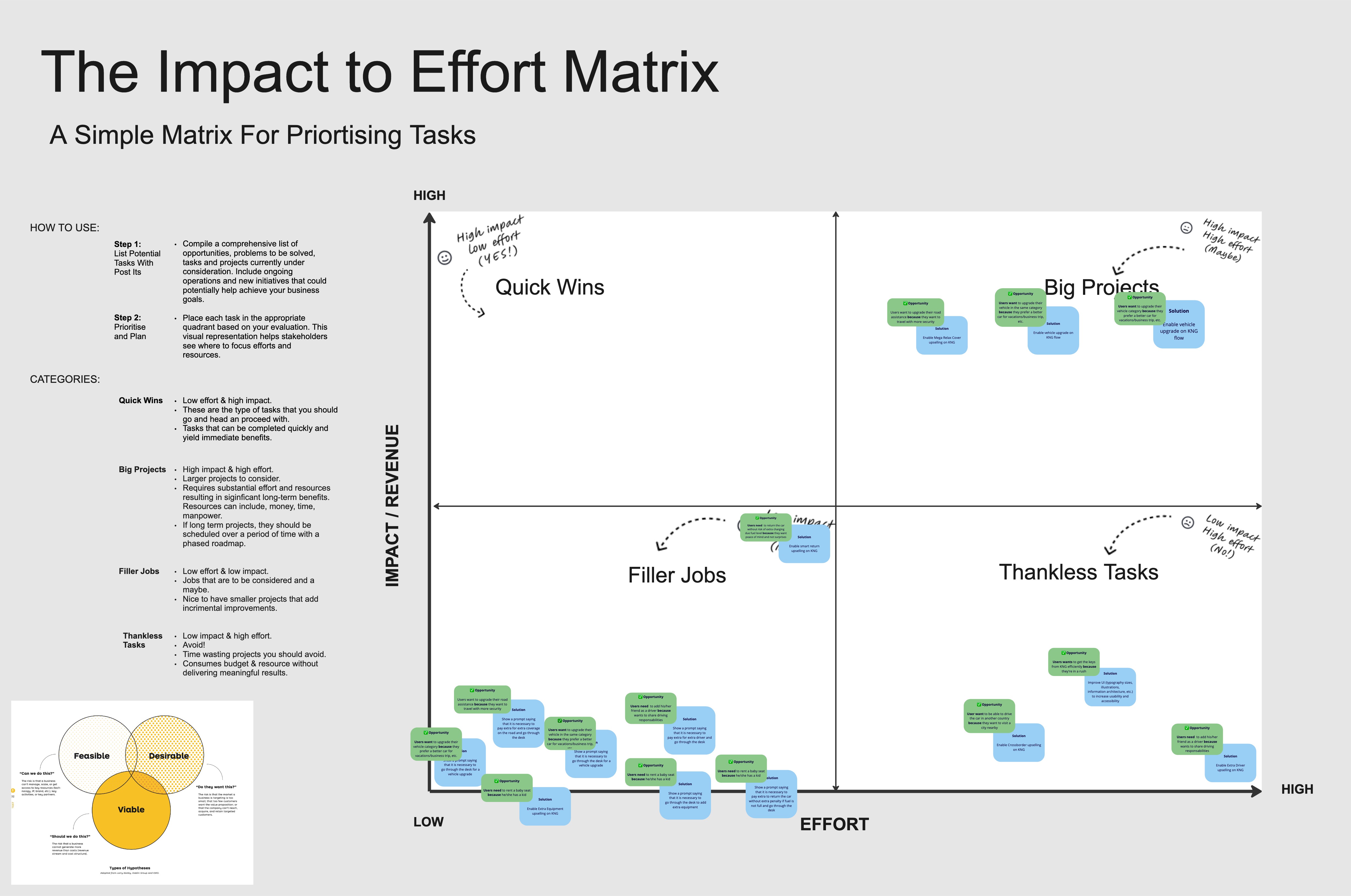
This mapping exercise helped us prioritize what to test first (e.g. insurance upsells via Mega Relax) and what to defer (e.g. full vehicle upgrade integration, which required more operational readiness). It also ensured that each design decision was grounded in validated insight — not just assumption or internal pressure.
Gradient 1 - Blue
Opportunity tree

Alignment

Given the strategic importance of the Key’n Go channel, aligning with business stakeholders, legal teams, and country managers was a critical step before moving into solution design. We facilitated multiple alignment sessions across departments to ensure that the proposed upselling features met revenue goals, legal compliance, operational feasibility, and user experience standards.

From a business standpoint, the goal was clear: replicate the counter’s ancillary conversion rates in the kiosk flow without increasing friction or damaging NPS. Legal teams helped define what could or couldn’t be shown to customers, especially around consent, contract updates, and cross-market variations. Country managers brought valuable context about local rental station operations, customer behaviors, and market readiness — ensuring we weren’t designing for an abstract “average” user.

This cross-functional alignment enabled faster decision-making, a clearer scope for the MVP, and built the foundation for scalable rollout. Everyone agreed on a shared vision: deliver a self-service experience that doesn’t just replace the counter, but enhances it with smarter, customer-driven upselling.
Slide image or video
Alignment meetings with stakeholders

Insights

Insights

Insights

1

Speed is sacred
Users deeply value the fast, no-hassle nature of the Key’n Go experience. Any upselling intervention had to respect this expectation — no long flows, no mandatory steps, and no ambiguity.

2

Lack of visibility = missed opportunity
Without prompts or context, users weren’t even aware that they could enhance their rental with extras. Transparency and surfacing options at the right moment were key.

3

Timing matters
The best moment to introduce upsells is just before confirmation — when the user feels in control and confident, but hasn't yet mentally “completed” the process.

4

Trust over pressure
Counter interactions benefit from human reassurance. At the kiosk, trust must be built through clear copy, comparisons, and visual simplicity — not by pushing offers aggressively.

5

Not all markets are equal
Operational realities, customer behaviors, and legal expectations vary by country. The solution had to be flexible enough to adapt to local constraints without fragmenting the core experience.

6

Insurance has the highest potential
Based on both internal data and external studies (e.g. KANTAR), protections like Mega Relax not only drive revenue, but also contribute to customer peace of mind — making them the ideal starting point for MVP.

Impact

The upsell flow affected the full journey.

Transparency

Clear, upfront info built trust and reduced doubts.

Simplicity

Less friction = faster, more confident decisions.

Reliability

What users see must match across all touchpoints.

Testing

Before scaling the upselling experience across all Key’n Go kiosks, we launched a focused testing phase to validate both usability and business impact. The goal was to ensure that the new flow respected user expectations for speed and clarity, while also proving its potential to drive ancillary sales.


We conducted end-to-end tests in live environments, starting with pilots in selected stations. These stations were chosen based on volume, operational readiness, and regional diversity to capture a broad range of user behaviors. Each pilot tested the upsell journey from screen interaction to confirmation and payment, with special attention on the Mega Relax insurance offer — our MVP focus.

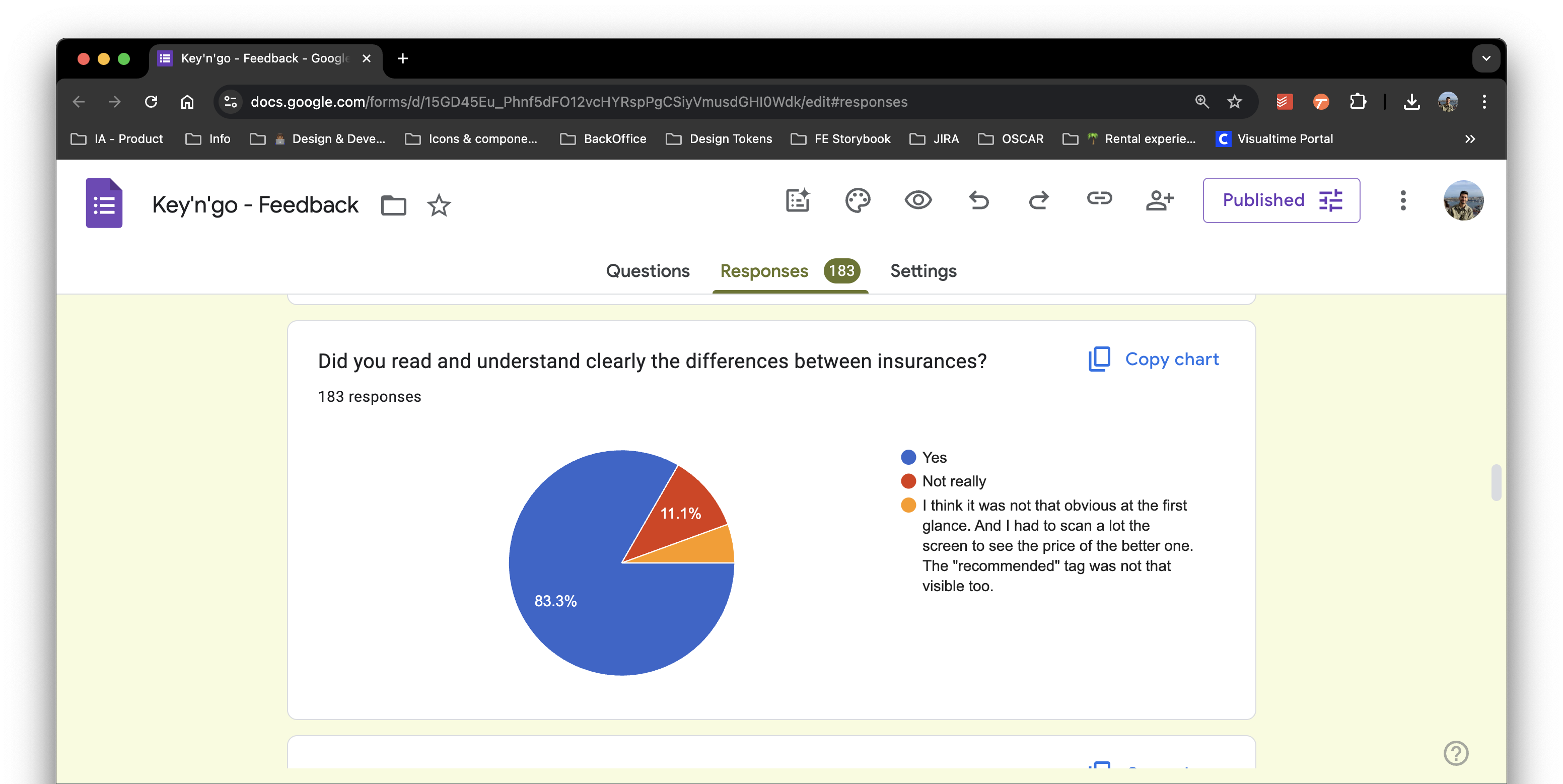
We collected both quantitative metrics (attachment rate, time on screen, drop-off points) and qualitative feedback (via station staff and user intercepts). Initial results were promising: users engaged with the upsell screens without signs of confusion or friction, and early data suggested a measurable uplift in conversion compared to the control flow.


The feedback loop with station teams was critical. It surfaced minor UX tweaks (e.g., improving copy tone, emphasizing optionality, optimizing button hierarchy) that helped fine-tune the experience before full rollout. The success of the testing phase gave us confidence in the product direction — and strong internal buy-in to proceed.
Gradient 1 - Blue
Test feedback

Refining

Following the initial pilot and testing phase, we entered a refinement loop to address usability friction, improve clarity, and fine-tune the upselling strategy. This phase was critical to transition from a functional MVP to a polished experience ready for scale.

Based on early observations and user feedback, we identified several quick wins. For example, users hesitated when the upsell screen appeared unexpectedly — so we added a short transition message to explain the purpose of the screen and reassure them that the step was optional. We also adjusted the copy to shift from sales-driven language to benefit-driven messaging, focusing on peace of mind and flexibility rather than protection tiers.


Visual hierarchy was another key area of iteration. We reworked button sizes, contrast, and layout to make choices more intuitive — especially under time pressure. To avoid drop-offs, we ensured users could clearly identify the “continue without adding” path, avoiding any perception of forced upselling.

On the backend, we collaborated with legal and tech teams to ensure the selected ancillaries were correctly reflected in the updated rental agreement, and that users received a copy via email post-transaction.

These refinements were rolled out progressively during the pilot and helped lift confidence internally. They also served as design principles for the next set of upsell integrations — including other ancillaries like crossborder and extra driver.
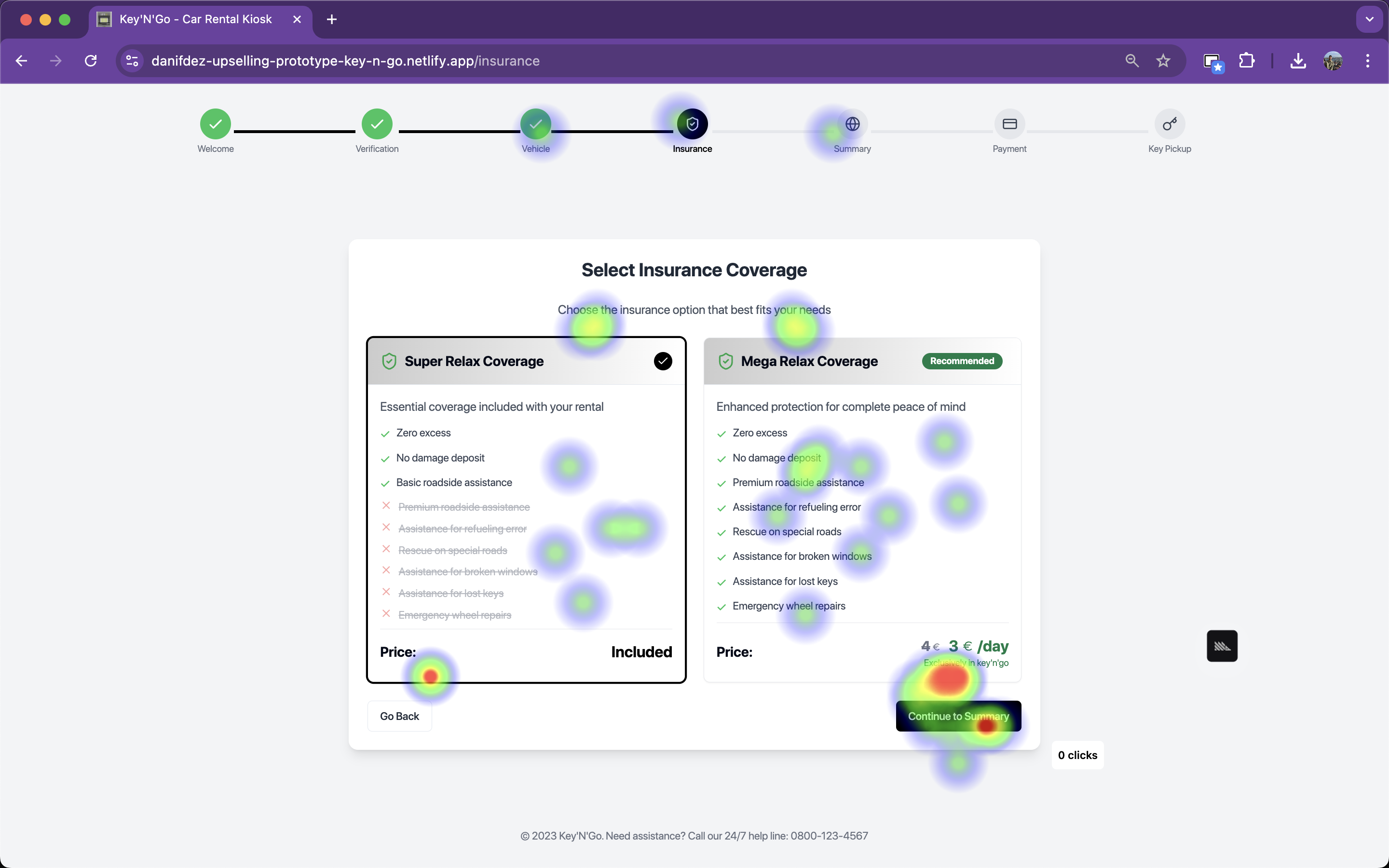
Gradient 1 - Blue
Headmaps

Design

Results

The introduction of upselling at Key’n Go marked a significant step in transforming the kiosk from a purely functional handover point into a strategic revenue channel. Early results from the pilot confirmed both business impact and user acceptance, validating the approach and setting the stage for broader rollout.

Overall, the pilot confirmed that users are willing to engage with upselling in a digital context — when it’s done right: transparently, contextually, and without friction.

+0M€
+0M€

Potential global revenue

13%
13%

Rentals through Key'n Go

+0%
+0%

Attach rate

-6%
-6%

Time at the counter

-6%

Time at the counter

Learnings and reflections

Learnings and reflections

After launching OSCAR across 1,000+ Europcar stations in over 20 countries, the platform quickly became the operational backbone for vehicle management.

The rollout not only achieved its measurable business goals, but also transformed the daily work of thousands of employees.

After launching OSCAR across 1,000+ Europcar stations in over 20 countries, the platform quickly became the operational backbone for vehicle management.

The rollout not only achieved its measurable business goals, but also transformed the daily work of thousands of employees.

Main takeaways

Main takeaways

Introducing upselling into a self-service flow required more than just adding screens — it demanded a deep understanding of user behavior, trust dynamics, and the operational realities of car rental stations. One of the most valuable lessons was that speed and autonomy don’t have to come at the expense of business goals. When offers are framed clearly and respectfully, users are willing to engage — even in time-sensitive contexts like kiosk pick-up.

Imoprtance of cross-functional alignment. Legal, operations, product, and local markets all had legitimate constraints and priorities. By involving them early and often, we avoided rework, ensured compliance, and built internal momentum that made implementation smoother.

What went well

What went well

Cross-team collaboration was strong from the start, especially with legal, operations, and country managers — helping us move fast with fewer blockers.

The MVP approach helped us stay focused: starting with Mega Relax let us validate the concept before scaling to other ancillaries.

On-site research provided valuable insights we wouldn't have uncovered from the office — small behavior patterns made a big difference in design decisions.

Early pilot results showed real business potential without harming NPS, which helped secure buy-in for the next steps.

What could be improved

What could be improved

We could have engaged marketing and customer service earlier to prepare messaging across all touchpoints.

The kiosk hardware had limitations that slowed down iteration — we had to work around constraints rather than rethink the full experience.

Some legal requirements surfaced late in the process, creating friction during the rollout phase. A clearer legal framework from the beginning would have helped.

Personal growth

Personal growth

This project deepened my understanding of designing for hybrid environments — where digital and physical experiences overlap, and UX has to work across constraints you can’t always control. It also strengthened my skills in stakeholder alignment, helping me balance user needs with legal, business, and operational realities. Most importantly, it reminded me that good design doesn’t just solve problems — it opens up new possibilities.

Money

Get paid on-demand and make saving second nature.

Break free from pay cycles with InstaPay—the flexible, credit-free way to get paid

Score your own Swag Visa Debit card and Swag Spend account

Shop with Google Pay or Apple Pay

Learn More

Dani

Last updated Nov. 2025

Let's make something together

I am a digital product designer specialised in apps and web applications. Feel free to send me a message for possible collaborations, new connections, or projects.

Dani

Last updated Nov. 2025

Let's make something together

I am a digital product designer specialised in apps and web applications. Feel free to send me a message for possible collaborations, new connections, or projects.

Dani

Last updated Nov. 2025

Let's make something
together

I am a digital product designer specialised in apps and web applications. Feel free to send me a message for possible collaborations, new connections, or projects.

Create a free website with Framer, the website builder loved by startups, designers and agencies.